Tuesday, 13 December 2011

The Young Apprentice; An Overview

The 12th December marked the end of yet another series of The Young Apprentice. The twelve young, enthusiastic teenagers have been on an educational journey where they were required to work as a team but shine as individuals; some more successful than others. They were set various tasks to test their business knowledge, skills and teamwork. Team names were Atomic and Kinetic and remained Boys Vs. Girls for the first two weeks until Lord Sugar mixed up for the remainder of the series. Below is an overview of the series outlining the task, happenings during the task and the results.

Week 1: Frozen Treats
Task: Produce own range of frozen treats to sell to public

Teams: Boys (Atomic) Vs Girls (Kinetic)

Managers: Harry H (Atomic), Hayley (Kinetic)

Products:
Atomic: Cookie and marshmallow ice cream and apple and watermelon sorbet (‘Shiverrrr me Timbers’ pirate theme), very low prices
Kinetic: Healthy ‘Treat and Trim’ theme with strawberry and marshmallow, chocolate and banana and mango and vanilla flavours, very high prices

Results:
Atomic: Costs £117.92, Sales £677.17 = £559.25 profit
Kinetic: Costs £131.00, Sales £839.34 = £708.34 profit

Fired: Mahamad (only sold £62’s worth)

Week 2: Parent & baby
Task: Create a new and exciting product for the parent and baby market and pitch to 3 retailers (same teams as last week)

Managers: Lewis (Atomic), Gbemi (Kinetic)

Products:
Atomic: ‘Harris the Hippo’ toy bottle warmer
Kinetic: ‘Comfy Curve’ cradling cushion armstrap

Results:
Atomic 1,200 units from JoJo Maman Bébé, 0 orders from John Lewis and 4,000 units from Mothercare = 5,200 units
Kinetic: 0 from JoJo Maman Bébé or John Lewis, but 7,000 units from Mothercare = 7,000 units

Fired: Ben (no inspirational ideas and failed to put himself forward)

Week 3: Floristry business
Task: Make arrangements within 2 days to sell to the public and pitch to three pre-arranged corporate clients who would then choose either Atomic or Kinetic (5 star hotel, West End theatre and an exclusive hair salon)

Managers: Hannah (Atomic), Lizzie (Kinetic)

Clients:
Atomic: 4 bouquets for Theatre and 4 window displays for Hair Salon
Kinetic: 5 posies and mantelpiece display for Hotel

Selling:
Atomic: Bouquets at £3,£6 and £10 (depending on size)
Kinetic: Triple pricing strategy (put forward by Hayley)

Results:
Atomic:  Sales £858.25, Costs £407.29 = £450.96 profit
Kinetic:  Sales £912.10, Costs £448.58 = £463.52 profit 

Fired: Hannah (brought the wrong people into the Boardroom)

Week 4: Over 50’s market
Task: Choose 2 products from 8 suppliers to sell at Kensington Olympia’s over 50’s show

Managers: Haya (Atomic), James (Kinetic)

Products: Atomic chose pie maker and bird box whilst Kinetic chose shopping trolley and mini vacuum

Results:
Atomic: Pie maker £347.42, Bird box £500.00 = £847.42
Kinetic: Shopping Trolley = £329.98, Mini Vacuum = 808.79 = £1138.77

Fired: Lewis (Lord Sugar admired his enthusiasm but told to talk less)

Week 5 - Deodorant
Task: Design, package, brand and create an advert for an anti-perspirant deodorant for teenagers then pitch infront of industry experts

Managers: Zara (Atomic), Harry M (Kinetic)

Products:
Atomic: RAW, male market, filmed street dancer doing routine in sports hall for advert. Harry H pitched
Kinetic: Vanity, female market, filmed teenagers and geek in basement club, Lizzie pitched

Results:
Atomic: Very good advert, one of the best in the boardroom
Kinetic: Good concept but their execution failed and the product wasn’t associated with the advert

Fired: Gbemi (poor product design despite this being her main hobby)

Week 6 – Discount buying
Task: 10 hours to find and buy 10 items on the list for Madame Tussauds (items ranged from a Justin Bieber 34” sized suit to a Dashiki for Nelson Mandela). Teams told they would receive penalties for not getting items (£50 plus guiding price) or not negotiating lower price.

Managers: Lizzie (Atomic), Haya (Kinetic)

What happened:
Atomic: Spent hours making phone calls locating some items, didn’t find them all, items more expensive than Kinetic’s
Kinetic: Set off straight away (no strategy), used Haya’s knowledge of London, constantly looking out for possible locations

Results:
Atomic: 6 items bought, Costs: £963 Fines: £517.87 = £1480.87 total costs
Kinetic: 7 times bought, Costs: £721 Fines: £248.10 = £969.10 total costs

Fired: Hayley (very polite and enthusiastic but often stays in the shadows)

Week 7 - Popcorn
Task: Develop some unique flavours of popcorn to pitch to 3 retailers (Jet2, Odeon and Morrisons)

Managers: Harry H (Atomic), James (Kinetic)

Products:
Atomic: Mediterranean themed (La Popcorn) – Chorizo and tomato, feta cheese and olive
Kinetic: American themed (Empire State) – BBQ chicken, maple syrup and pancakes

Results:
Atomic: 10,000 from Odeon, 50,000 from Jet2 and 30,000 from Morrisons = 90,000 units
Kinetic: 15,000 from Odeon, 0 from Jet2, 100,000 from Morrisons = 115,000 units

Fired:
Team Atomic (Harry M, Harry H and Lizzie)
Haya from Kinetic (not seen any creativity but told she shouldn’t give up because she has great attributes)

Week 8 – Video Game (The Final)
Task: Create a new online video came with a viral Internet advert and pitch to professionals in gaming and online (ranging from Facebook to Disney) and Lord Sugar himself. Previous candidates from the series returned; Lewis, Harry H, Hayley, Lizzie and Hannah join James while Ben, Mahamed, Harry M, Gbemi and Haya lend their support to Zara.

Products:
Zara: After many ideas were developed, Zara decided on ‘Piggy Panic’ – players are required to help Porky Pete from the butcher
James: Market research showed that the public would prefer their puzzle game but James took a risk and decided on ‘Crazy Cabinet’ – a time management game whereby the player plays the role of Prime Minister

Pitches:
James: Game relates to current affairs; concerns about running the country and everyone says they can do a better job. His spoof advert amused the audience and was seen as a great concept and “witty” game with clear scope to expand to keep the game current. He clearly understood the target market with a comical advert that was offensive to some degree; suited to its audience.
Zara: Clearly very passionate and enthusiastic about her product and also managed to amuse the audience with her game demo and viral ad. A game with “lots of potential”.

The Boardroom:
James: Told his advert didn’t correlate with the game
Zara: Informed her pitch was impressive, game not got the migration of James’ but clear development of characters in books, for example, and her advert engaged more with the game

The £25,000 prize:
Zara explained she would invest in professional filming equipment and sell productions. James, on the other hand, wishes to study Economics further before producing, developing and selling an idea that he develops. The winner receives the prize to build their future but once when Lord Sugar approves its use.

Hired: Zara

Conclusion
Overall, it was clear to study the group dynamics and the effect this has on motivation, creativity and innovation. All tasks were designed to test candidates’ abilities in many business areas including creativity and the ability to be resourceful. During Week 5’s deodorant task, members in Kinetic explained they found Harry a very difficult individual to work with and wasn’t creative enough which was critical because creativity in this area was essential to succeed; hence why this team lost the task. Also during this task, conflicts arose in Atomic whereby Zara’s dominant leadership style led to her disregarding Hayley’s thoughts and ideas. This can cause high demotivation in the business world and discourage future co-operation.

Meeting at Madame Tussaud’s for the task of Week 6 illustrated the importance of keeping up to date. This business has been in existence for over 200 years creating waxworks of famous people making it essential to keep up to date to ensure every detail is correct and accurate. This means that items need to be constantly replaced.

Throughout the series, it was apparent that candidates take credit for others’ decisions when they are successful. For example, in Week 6, Zara took credit for Harry M’s idea to contact a library to look up ‘Dashiki’ in a dictionary because Internet usage was forbidden throughout the task. The series also highlighted the importance of communication and the impact this has on motivation and the ability to be creative within a group. Harry M, for example, has consistently been told he is good at selling and negotiating but rarely listens to others and pursues his own ideas.

Each week, Lord Sugar provided feedback to the candidates; highlighting any strengths and weaknesses they may have. This enabled the individuals to learn from their mistakes; a concept relevant to innovation whereby businesses can learn from their own and competitors’ errors when bringing innovations into the market.

In Week 7, it was clear to the candidates that they had to work as a team to have a chance of winning both as a group and individually as the losing team were all fired in addition to one member from the winning team. Communication and teamwork was essential. Haya was one of the four fired from this episode but reflected on the importance that it’s ok to take risks; a critical aspect in innovation.

During the final series, Zara expressed she was a “naturally creative person” and is a highly determined individual who is always willing to put ideas forward, take risks and experiment; trying out lots of different ideas. However, this means that she doesn’t always consider the views, opinions and ideas expressed by others; wanting to steer from the back when not the leader. James also developed the ability to become a risk taker, put his neck on the line and pursue ideas but listen to others managing to understand how to work within a team and get the best out of each member.

References:
The Young Apprentice (2011) [TV Broadcast] BBC1, Every Monday, Week commencing 24th October. 21:00 hrs

Saturday, 10 December 2011

Marketing; Its role

There’s no doubt that marketing plays an important part; either as an innovative advertising campaign in itself or emphasising a company’s innovative products and/or services. As defined by Jobber, the marketing concept is “the achievement of corporate goals through meeting and exceeding customer needs better than the competition” (2007:1001). “Management must think of itself not as producing products, but as providing customer-creating value satisfactions” (Levitt, T. cited in Jobber, D. 2007:3).

Marketing campaigns aim to interest and engage potential and existing customers to cause them to want to watch the advert again; maintaining a company’s stakes and messages that it wants to portray. The important element of marketing is that a business can always improve its stakes and image; making innovative marketing a critical aspect.
As explained by Virgin Atlantic’s Sales and Marketing Director at a University talk, the company’s £10 million global marketing campaign in the UK was designed to build the airline’s brand presence on a global scale and was used to significantly increase demand for its services. The strapline "Your airline’s either got it or it hasn't" was created following their 25th birthday campaign last year “Still Red Hot” which was one of the top ten marketing moments of 2009 by Campaign Magazine. Many people describe travelling with Virgin as being special and different; as illustrated by their marketing campaign that gives them a competitive edge. In January/February 2011, Virgin Atlantic spent £1,869,222 on advertising their brand on TV and their return was £23.46 per £1 spent! A media plan needs to be efficient, productive and incorporate an awareness of budgeting which has clearly been, and is, successfully implemented by this company in particular.

Product Life Cycle & Innovative Marketing
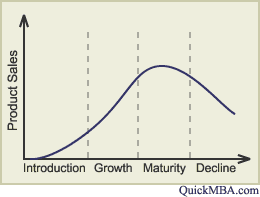
The product life cycle is “a four-stage cycle in the life of a product illustrated as sales and profit curves” (Jobber, D. 2007:1002). These stages include: introduction, growth, maturity and decline. As well as products, adverts also have a lifespan making it vital to create innovative marketing campaigns that are more powerful each time; therefore a continual process. This could be achieved by extending campaigns outdoors by incorporating a snapshot from an advert; using photography to amplify a company’s assets and products. Due to the shortening of the product life cycle, marketing is crucial to implement extension strategies or to remind consumers that certain products still exist.


Innovative marketing requires companies to “continuously seek real product and marketing improvements” (Kotler, P. and Armstrong, G. 2006:639) and doesn’t overlook ways to improve its processes as this can consequently lead to customers using another company who has found a much better way.

In 1996, Samsung attempted to overtake Sony by releasing a wide variety of new, stylish and innovative products which were designed by a newly recruited group of designers. Their new product range was supported by a $400 million marketing campaign. The company is now well established in today’s market focusing on high-end and cutting edge technologies.
Another example of an innovative marketer is Colgate-Palmolive. According to Kotler, P. and Armstrong, G. (2003:615), “new products contribute 35% of Colgate’s revenues”.  It launched an extensive range of toothpastes that were highly successful amongst consumers. This was achieved through extensive market research allowing them to gain information regarding shifts in demographics and concerns. Today’s society has become more health-conscious due to the mass media reflecting on health issues throughout the UK and worldwide. Therefore, Colgate Total was released amongst many other products to provide customers with a variety of benefits. It reinforced its products through numerous innovative marketing programmes including health magazines which effectively targeted those members of the public who are well educated and are focussed on maintaining their health to avoid becoming another statistic. As a result, Colgate Palmolive became market leader “for the first time since 1962, with a 32% share versus Procter and Gamble’s 25%” (Kotler, P. and Armstrong, G. 2003:615).

Despite the shortening of the product life cycle as mentioned above, it is important for an organisation to not rush its product development to the extent whereby its quality can be severely affected (Kotler, P. and Armstrong, G. 2006:289). This is the risk some companies have to take to gain their competitive edge but through superfast product development, care must be taken to ensure products are developed at speed but whilst maintaining quality and improving previous/existing products. Kotler and Armstrong (2006:275) suggest that “more than 90% of all new products fail within 2 years”. This can be explained by a variety of factors; overestimated market size, actual product needed improving, incorrect positioning, too highly priced or advertised poorly.

Target marketing is significant in order to attract the right people at the right time; requiring careful consideration and thorough implementation. Masterston and Pickton (2004:110) define target marketing as “making decisions about which part of the market an organisation wishes to focus on”. From deciding this, strategies can be drawn up to communicate to the market segment(s) in the most effective and efficient way. Once a segment has been identified by a business, a product positioning strategy is developed. Through the design of the product, marketing mix and campaigns used this provides the basis of consumers’ perceptions to position the company into a given place Lancaster, G. and Massingham, L. 1999:191). Strategies such as micro-targetting can be used whereby the routes that certain people take can be researched and advertised accordingly. For example, posters can be displayed at particular Underground station exists to convert a potential customer into an actual customer.

Porter’s Five Forces
Porter’s well known Five Forces model (1980) allows organisations to assess and analyse the competitive strength and position of rival businesses. This model has been a valuable asset to managers since it was devised providing knowledge of the driving forces facing any corporation (McDonald et al 2000:132). Porter’s analysis becomes particularly useful for those organisations considering entry into a new market and therefore require an overview of current businesses.

Porter’s five forces are described by Masterton and Pickton (2004:77-79):
  • Threat of new entrants i.e potential competitors
  • Threat of substitutes; many alternative products and services can challenge competitive advantage
  • Bargaining power of customers; very powerful if more important to suppliers than suppliers are to them
  • Bargaining power of suppliers; if, for example, resources are scarce, suppliers can dictate the terms
  • Inter-rivalry of competitors; highly competitive industries can encounter price wars etc.
This model can be used for analytical purposes as well as a SWOT and PEST analysis. A PEST analysis most commonly measures a market whereas a SWOT analysis measures a business unit, proposition or idea.

SWOT analysis aids the decision-making process for a variety of business situations. It is an acronym for Strengths, Weaknesses, Opportunities and Threats. It can help review an organisation’s strategy, position and direction allowing a business to achieve a ‘strategic fit’ between itself and the environment (Lancaster, G. and Massingham, L. 1999:82). SWOT relates external opportunities and threats with the internal strengths and weaknesses held by the organisation.

PEST is also another useful model allowing consideration of market growth/decline, position, potential and direction. It is an acronym for Political, Economic, Social and Technological factors. It also considers the Legal and Environmental forces a business may face in the marketing environment (Masterton and Pickton 2004:61).

References:
Jobber, D.  (2007) Principles and Practice of Marketing, 5th Edition, Berkshire: McGraw-Hill Education

Kotler, P. and Armstrong, G. (2003) Marketing; An Introduction, 6th Edition, New Jersey: Pearson Education Ltd.

Kotler, P. and Armstrong, G. (2006) Principles of Marketing, 11th Edition, New Jersey: Pearson Education Ltd.

Lancaster, G. and Massingham, L. (1999), Essentials of Marketing; Text and Cases, 3rd Edition, Berkshire: McGraw-Hill Education

Masterson, R. and Pickton, D. (2004) Marketing; An Introduction, Berkshire: McGraw-Hill Education

McDonald, M, Rogers, B. and Woodburn, D. (2000) Key Customers; How To Manage Them Profitably, Oxford: Butterworth-Heinemann

Monday, 5 December 2011

Innovative or Inappropriate?

Here are some products that I believe are ‘Innovative’, ‘On the fence’ or ‘Inappropriate/Unsuccessful’. Every business experiences success and failure but do some bring out new editions just to keep its face in the picture and keep up with its competitors? Are businesses rushing their inventions to maintain their market share? No-one likes an unhappy customer!

IBM; Innovative
A University talk by two IBM placement students gave an insight into the works and wonders of the business amongst its many innovative products. IBM (International Business Management) are one of the world’s largest IT and consultancy services and was founded back in the early 19th Century evolving from a small business to one employing more than 400,000 people. Previously, they concentrated on manufacturing but more recently have adopted a consultancy approach; providing innovative solutions to business problems in a variety of industries.

Innovations
  • In 1969, IBM developed NASA technology which enabled man to land on the moon
  • The self-service kiosk was brought to market by IBM in 1970
  • The calculator
  • IBM invented the Universal Product Code (barcodes) over 40 years ago
  • Over 30 years ago, they lead the way in innovation; bringing personal computing to life
  • They created the processor chips that power Wii’s, Xbox 360’s and Playstations
  • In 2000, they launched ‘SMS for Life’ which allows health workers in developing countries to order malaria medicine via text message so that stocks are always in supply
  • In 2010, they introduced a Wimbledon Championship application for iPhones and Android devices which was downloaded by over 880,000 to watch live video feeds by pointing their phone in the direction of the court they wanted to see
Amongst many more from analytics to water, IBM are clearly a highly innovative business despite being ranked 29 on the 2011 50 Most Innovative Companies although 4th on the 50 Most Innovative Companies list by Bloomberg in 2010.

Graze; Innovative
Ever heard of Graze? Perhaps not. They are a fairly recent established business who specialise in delivering personalised healthy snack boxes straight to your desk via post. With the continuing concerns in society about obesity, healthy eating businesses are thriving. To receive their products, all you have to do is follow the simple steps on their website;
  1. Choose your box and how often you’d like to receive it
  2. View their products and rate whether you like, love or would like to try them
  3. They hand pick your box based on your ratings
  4. Box delivered first class
Each box contains four punnets of healthy snacks and contains a personalised nutrition guide explaining your snacks and the nutritional information. It costs £3.49 including delivery but if you’re a new customer, the first box is just £1.74. Deliveries can be cancelled at any time, there’s no commitment.
The healthy snack boxes are a good provider of energy, can help you lose weight, boost your immunity, provide you with a varied and balanced diet, keep with the 80/20 rule (be good 80% of the time and give yourself a treat) and maintain your blood sugar at a healthy level. I received one of their punnets as a trial run and was very impressed, so try it yourself!

Apple; On the fence
There’s no doubt that Apple’s technology has transformed our lives and the world of technology so you may be wondering why Apple are, as we could say, ‘on the fence’ in this discussion. Apple are always bringing out new editions with even more applications and improved features..so we’d like to think. Many have argued how quickly the iPhone’s battery needs charging even when all open applications have been closed. Despite this, many still queued up for hours outside their local store for the release of the newest version on 14th October; the iPhone 4S. Reportedly, 4 million handsets were sold in the first three days of release.

According to a BBC News article, “people claimed that their phone battery was draining by up to 15% every hour, even when the handset was not being used”. Apple have said that they have found a “few bugs” in the company’s latest mobile operating system (iOS 5) which is affecting the battery life of the device. With thousands of customers complaining about poor battery life on the company’s forums, something had to be done quickly if they were to keep their customers loyal, satisfied and with the brand. Within a few weeks, software updates were sent out to all handsets However, more concerning, some Apple customers are disappointed with their new iPhone as it “offered no radical changes” from the previous edition apart from its voice-control functions.

Could Apple be trying too hard to get out its new models? Is the competition from Google and Samsung affecting their performance? According to the research firm, Strategy Analytics, “in the third quarter of this year Samsung overtook Apple with 27.8m smartphone shipped compared to 17.1m iPhones" (BBC News, Accessed  26/11/11).

Nurofen; Unsuccessful
Nurofen is a well known brand selling over the counter painkillers. They are constantly innovating; finding new and improved ways to target pain relief to reduce discomfort of its consumers at an increased speed. However, one of its recent products (Nurofen Plus) was recalled over the Summer of 2011 after Seroquel XL 50mg (a harmful antipsychotic drug) was found in their products. This was found to be the case with 3 batches in South London despite the anti-psychotic drugs being manufactured by a different company. Pharmacy staff are now asked to double check the painkillers before selling to customers. However, although a manufacturing error isn’t being held responsible for this mix-up and that sabotage was possible, customer loyalty has severely been affected as trust is no longer in the equation and severe impacts on trust (Metro, Accessed 16/11/11).
From speaking to one of my sixth-form teachers, a student had taken one of these pills and was very ill as a result during a trip to Barcelona on a 30 hour coach journey; not a great situation to be caught up in.

Xbox; Unsuccessful
Microsoft’s Xbox 360 hasn’t been all successful. Game users have experienced many problems. In Summer 2008, approximately $1 billion was spent by the company on repairs as problems occurred due to the chips within the game station. Rumour states that this was due to Microsoft using cheap chips in the device. This was then followed by smoking race wheels due to overheating (CyberNet News, Accessed 26/11/11).

What the future has in store…
One of the biggest industries where innovations occur is, no doubt, science and technology. Things that we could only imagine are slowly becoming our reality with the high advancements in technology enabling innovations to come to life.

According to the BBC technology website, such innovations include:
  • Growing your own burger (without meat)
  • Controlling objects through thought processes
  • Rewriting human genes
  • Human-like robots to undertake everyday chores
  • A gadget called a biofuel cell which uses glucose and oxygen at concentrations found in the body to generate electricity
  • Using Abalone (a sea snail) shells for the future of manufacturing, green energy, medicine and science
Is science going too far or is this something we should expect?

References:
BBC News [online], Available from: http://www.bbc.co.uk/news/technology-15570462, Apple acts on iPhone battery bug, blames iOS 5, (Accessed 26th November 2011)

BBC News [online], Available from: http://www.bbc.co.uk/news/technology-14803871, (Accessed 26th November 2011)

CyberNet News [online], Available from: http://cybernetnews.com/xbox-360-wheel-recall-due-to-overheating/, (Accessed 26th November 2011)

Tuesday, 29 November 2011

Nasa’s innovation

On Saturday 26th November, NASA launched its recent $2.5 billion innovation to discover the planet Mars. At a weight of nearly one tonne, the rover is due to land on the planet in approximately eight and a half months time (August 2012). It has been nicknamed Curiosity which is exactly its purpose; NASA are intending to have many of their questions answers by using this invention – Are there any signs of previous microbial life? Is there potential for life on Mars? Curiosity has been sent on its mission to explore the area.


It has been designed using a plutonium battery which will allow its operation for more than 10 years; plenty of time for exploring the crater and climbing the summit of the mountain.

With its built in cameras, this smart innovation has the ability to assess its surrounding from a distance, search for sampling targets and examine surfaces and objects to study its chemistry. Also equipped with an infra-red laser system, this robot can ‘zap’ rocks to analyse its atomic elements and identify organic, carbon rich compounds. Other tools allow the Mars Rover to scoop up, sort and sieve samples – smart innovation!

Innovations such as these may come at a heavy cost but if providing a worthwhile return and increasing our knowledge of the World and Solar System, they are viewed as worthwhile investments; providing they work. Being innovative is all about taking risks which can be successful.

Was there life on Mars? Could there be life on Mars? Could we all be jetting off to Mars for our Summer holidays in the future? Only time will tell and now NASA awaits for Summer 2012 when their ‘Mars Rover’ reaches its destination…

References:
BBC News [online], Available from: http://www.bbc.co.uk/news/science-environment-15841893, Accessed 27th November 2011

BBC News [online], Available from: http://www.bbc.co.uk/news/science-environment-15904408, Accessed 27th November 2011

Monday, 28 November 2011

M&S; Success, failure, success

Towards the end of the 1990s, the well known brand Marks and Spencer suffered; profits fell dramatically and share prices plummeted. Consumers viewed their clothing unfashionable and their food range suffered as the public shopped with other brands and major UK supermarket chains for quality food. In May 2000, a new Chairman was appointed to help M&S regain its, once loyal, customers. Change wasn’t achieved as quickly as he’d hoped and in 2001, many of its overseas stores were closed. Given another 12 months to bring M&S back to life, it was announced in May 2002 that the company had experience a soar in profits and share prices; on the way to recovery.

Many suggest that M&S suffered due to the inability to manage change, keeping updated and satisfying customers’ needs and expectations in the changing marketing environment resulting in a “scatter-gun approach to innovation and change” by the public limited company (Bilton, C. 2007:122). Consumers preferred to shop at other High Street brands and “M&S responded to the decline in its existing business by attempting to innovate its way out of trouble” (Bilton, C. 2007:123). This was achieved by the introduction of new franchises such as Per Una as well as the creation of new products and services (such as financial solutions). However, such radical changes clashed with existing customers and the company’s established identity.

M&S has clearly learnt, albeit the hard way, and is now retaining its loyal customers and increase their engagement. Continuous marketing campaigns including celebrities such as Mylene Class help to reinforce the brand image and keep its customers shopping with them.

This has clearly demonstrated how such a successful company can lose its way when focus is taken away from its customers and not engaging fully with the market leading to a lack of understanding of needs and wants. In today’s economy, many businesses are finding it hard to uphold their innovative ways as budgets are squeezed and priorities lie with basic survival against rivals. However, innovation is still important and can significantly affect customers’ perceptions of the company and its products if competitors are always seen to be one step ahead of the game.

Innovations can make or break a business. In the case of M&S, innovations such as the introduction of the Per Una range conflicted with its established identity, however, it could be argued that this was a necessary and crucial radical innovation to make. The public are usually very cautious of radical changes such as these, but they can be convinced and persuaded, in due course, that radical innovations aren’t always negative. In such a fragile state, many may say that M&S needed to rebrand itself in order to catch people’s attention and attract its existing and potential customers back to the store.

Marks and Spencer are well known for their concentration on delivering quality to the best possible standard and either meeting or even exceeding customer expectations at an affordable price. The public limited company are continuing to improve their ranges of food and clothing my upholding its image of high quality to establish and retain its market position as a high quality, but innovative, retailer.

References
Bilton, C. (2007) Management and Creativity; From Creative Industries To Creative Management, Oxford: Blackwell Publishing Ltd.

Friday, 25 November 2011

So what are the different types of innovation?

There are various types of innovation; some of which are described below accompanied by examples.

Incremental, radical or revolutionary?
Incremental changes are those of small and slow measures. Such examples include Gillette’s razors and its increase in the number of blades from two through to five (McKeown, M. 2008:3). Changes such as this aren't drastic and sometimes may not even be acknowledged. However, slow changes may be appreciated by loyal customers who dislike the concept of change.

In contrast, however, innovations can be radical i.e larger steps of change. Amazon, for example, was one of the first to develop the concept of selling books online (more than a typical bookshop would sell). This idea has now developed and now sells a broad selection of items in addition to books. The reason Amazon is so successful is because it developed the idea much better than that of its early rivals.

Further impact can be achieved via a collection of innovations; these are called revoluntionary innovations.

Innovations can be developed from incremental to radical leading to revoluntionary. However, some businesses take risks and attempt to introduce revoluntionary innovations without taking the vital primary steps.

Other forms of innovation
Product innovation is thought to be the most common and can be defined as “new products or services introduced to meet an external and market need” (Damanpour, F. 1991, cited in Afuah, A. 1998:14). This demands organisations to keep highly engaged with their customer base to gauge their dynamic needs, wants and expectations. Innovations are an ongoing process. For example, there have been numerous incremental innovations of the Bic ballpoint pen since its original version.

Smartphones are another, but more recent, example of a product innovation; a high-end mobile phone with enhanced abilities of standard mobile phones combining the features of a digital assistant and a mobile phone. More recent models of smartphones have incorporated aspects of media players, navigation systems, digital cameras, web browsers (using Wi-Fi) and high resolution touch screens.

Dell, the well known computer hardware and software company, went from selling hundreds of standard laptops to selling millions of their new innovative product globally; a laptop with interchangeable coloured lids all within two and a half months.

In contrast, process innovation involves “new elements introduced into an organisation’s production or service operations – input materials, task specifications, work and information flow mechanisms, and equipment used to produce a product or render a service” (Damanpour, F. 1991, cited in Afuah, A. 1998:14). Altering the way in which an organisation operates can lead to high efficiency through cost reduction and can, therefore, be a key way to achieve competitive advantage. This is because, unlike products, processed can be more difficult to imitate due to financial constraints, for example.

Online shopping has become ever increasingly popular and a recent UK survey has found that people, on average, spend 161 minutes on the Internet on a daily basis compared to just 148 minutes watching television. This highlights the shift in society towards a more electronic way of thinking.

Such enhancements in manufacturing processes can concern the adaptations of companies usage in just-in-time delivery (JIT). Also know as the Toyota Production System, this process allows organisations to receive its materials when required using signals during different points of the process. It focuses on continuous improvement and can significantly improve a business’ return on efficiency, quality and efficiency by reducing the costs associated with storing materials and products in warehouses.

Operating efficiently as possible is the key for process innovations. Enterprise Rent-a-Car emphasised in their talk how cost control is a major priority for their company. At any one time, there are only two cars in their car park. They believe that a full carpark is a sign that they are losing money; highlighting the importance of strategy and forward planning. In such an economic climate as today, losing money is to be avoided at all possibilities.

Business process innovation can range from improving or expanding the supply chain, to delivering faster customer service and targeting new customers and markets. Most importantly, this is a cost reducing exercise that also enables organisations to deal with and serve customers at greater ease; an important element for any successful organisation.

Organisations can also engage in position innovation i.e repositioning the perception of an established product or process in a specific context in the eyes of their existing and potential customers. A focus is required on how products, services and companies are viewed symbolically and how they are used. Attempts to achieve this could be through successful marketing campaigns to alter people’s way of thinking.

Innovation within marketing can be critical to a business’ success. We are forever seeing innovative television adverts that capture our attention and encourage us to purchase the products or services being advertised. However, a recent surge in the usage of social networks, such as Facebook and Twitter, have proven to provide businesses with social media platforms. A few years ago people thought marketing by text was innovative…

Business model innovation refers to creating or reinventing a business to immerse itself into new market segments, gain significant advantage over competitors and competing on more than just value proposition. Making reference to Dell once more, whilst its rivals and businesses in various other sector were selling their goods via dealers and retail outlets, Michael Saul Dell (CEO) decided to sell directly to the consumer.

Previously, in order to receive, purchase or enquire about an insurance quote, one would have to contact via phone or be contacted by their supplier as a reminder to insurance your car or property. Now however, due to the over-reliance of the Internet, websites such as Compare The Market have emerged; enabling us to compare prices of insurance suppliers to find the best deal that’s cost effective but also reliable, appropriate and suitable.

References:
Afuah, A. (1998) Innovation Management; Strategy, Implementation, and Profits, New York: Oxford University Press Inc

McKeown, M. (2008) The Truth About Innovation, Harlow: Pearson Education Ltd. 

Monday, 21 November 2011

Branson's pride and joy; Virgin Atlantic

As outlined in the first blog post, the Virgin Atlantic event was arranged by the University’s Marketing Advertising and Public Relations Society (MAPR) where the Sales and Marketing Director, Paul Dickinson, gave a very informative and interesting talk giving an outline of Virgin’s history as well as some successful innovations, insights into their marketing campaigns and the everyday running of the company.

Some background information
Firstly, he pointed out that Virgin is all about image which is enforced through communication, advertising and inter-relations. Virgin is a well established brand and has been around for approximately 27 years due to its unique edge to survive in the competitive market, unlike many during the recession.

Unlike other airlines, Virgin owns 28 aircraft in the UK compared to its rival, British Airways, owning 250 aircraft. Many people believe Virgin to be bigger than its actual size due to the establishment of the brand. The company is known for its long haul and worldwide flights to over 30 destinations and has been calculated to be amongst the top 30 airlines in the world. Revenue equates to approximately £2bn and is still a private company with 51% being owned by Sir Richard Branson himself and the remaining 49% by Singapore airlines.

Three of Virgin’s priorities are:
  • Brand commitment – achieved through word of mouth, customer service, products and memorable marketing
  • Acquisition – via their loyalty programme and gaining data
  • Retention – enhance loyalty and selling other items to their customer base such as insurance or Internet.

Virgin has realised that after money, people’s next priority is travel. Whatever the company or its size, travel receives high media coverage; such as the effect of the ash clouds on the running of the planes.

Although remote from the office, Branson is the figure head of Virgin used for Public Relations purposes. He established Virgin on the basis that he felt he could make a difference and look after customers better than he’d experienced by other companies.

Some highs…and some lows
Despite appearing a highly successful and established brand in the eyes of the public, this hasn’t always been the case. For example, Branson’s attempt to introduce Virgin Cola to the market was a highly unsuccessful venture as it appeared to have no benefit over the current competition with customers remaining loyal to brands such as Coca Cola and Pepsi.

On the upside, Virgin has had some extreme highs. Who’d have thought that they were the first airline to provide in-the-seat TV screens for its passengers. Paul explained that it’s impossible to always be ahead due to the associated costs. This is true for Virgin at the moment with their technological advancement updating current TV screens into an iPad-type device whereby passengers can flick through films, rate, choose, connect their phone and complete quizzes. This all sounded very impressive until Paul told us the price…£5m per aircraft!

In addition, Virgin also introduced the concept of ‘Premium Economy’ seating to their aircraft as they believed the gap and price range between ‘Economy’ and ‘Upper Class’ was too large and needed to introduce a middle level. This enabled Virgin to stand out…until other companies observed their success and imitated this; a clear example to show how innovations, especially those encountering high success, can never be protected from the imitation by competitors even if patents are obtained to avoid this from happening. Paul described the ‘Upper Class’ for passengers including all inclusive spas, hot tubs, pools, bars, beauty salons and much more. It’s no wonder some passengers turn up hours before their flight is due to leave to get their money’s worth of the facilities!

The above innovations, amongst others, demonstrate Virgin’s attempt to differentiate itself and stand out from its competitors.

Innovating beyond the norm of the airline industry
Virgin have realised that business travellers are their most valuable customers. This customer base is time-conscious and Virgin took this as an opportunity to innovate. At Terminal 3 in Heathrow Airport, Virgin spent £10m helping its business men and women avoid the long queues in the ‘U-Class Wing’ – gaining significant competitive advantage. It took 3 years to build and is designed as a terminal within a terminal using an integrated approach. Passengers experience a private security channel which is empty the majority of the time and £1m a year is spent on extra staff for this venture to succeed. It has been advertised as ‘Limo to Lounge in 10 minutes’. The passenger is met when they arrive by a member of staff with their travel ticket before entering security and straight onto the aircraft. Virgin highlighted this niche audience and primarily is aimed at males aged 35-55 years old. This specific audience allows more efficient targeting.

Overall, Virgin is a strong brand with loyal customers who like what they do through their excellent customer service, product innovation and memorable advertising. They believe measuring effectiveness is a key element in terms of improving in the future.


According to Sir Richard Branson himself:
“An innovative business is one which lives and breaths “outside the box”. It’s not just about ideas. It’s about a combination of good ideas, motivated staff and an instinctive understanding of what your customer wants and then combining these elements to achieve outstanding results” (Clegg, B. (2001:96).

References:
Clegg, B. (2001) Creativity and Innovation for Managers, Oxford: Butterworth-Heinemann